|
|
|

|
Introduction |
This informal, nonacademic book contains my results on questionnaires, or self-tests, focusing on a variety of subjects. In my mind, all of them relate – directly, indirectly, or, in the case of codependency, perhaps inversely – to the Autism spectrum. Links are provided, within each of the twenty-six sections, for those readers who wish to take one or more of the tests. Obviously, I cannot guarantee that these questionnaires will always be available, and I assume no responsibility for anyone's degree of satisfaction or dissatisfaction with the outcomes.
Sections I, II, III, IV, V, VI, VII, VIII, IX, X, XI, XII, XIII, and XIV, present results on self-tests designed to measure (not diagnose) Autism Spectrum Disorder (ASD). It should be borne in mind, however, that there are no generally accepted clinical tests for ASD. Most psychiatrists and clinical psychologists rely upon taking a verbal history and on direct observation.
Section XIV reports self-test findings for symptoms somewhat related to what occupational therapists and some elementary school educators term sensory processing disorder (SPD). Although SPD is not recognized in the DSM-5, it has been included in the Diagnostic Manual for Infancy and Early Childhood of The Interdisciplinary Council on Developmental and Learning Disorders (the ICDL-DMIC). Some skeptical clinicians define its traits as properly belonging to the Autism spectrum. Others consider it to be a primary disorder in its own right or a comorbid condition to “ASD.”
Section XV describes the end products of three tests intended to indicate codependency. As a social scientist, I am highly skeptical regarding the overall empirical utility of the variable. I also regard it more as social criticism and philosophy than as psychotherapy. The codependence construct, in my view, reflects exaggerated American concepts of freedom, rugged individualism, and libertarianism. However, my informal prediction that codependency, in the manner in which it has generally been constructed (control and enablement), would be inversely associated with Autism appears to be borne out in my own case. All three scores were in their lowest respective categories. An apparently similar concept, though based on transactional analysis, is Karpman's Drama Triangle (developed by Stephen Karpman, M.D.), which is explored further on this website.
Section XVI discusses a test designed to measure narcissism, perfectionism, and aggression. My type (NP) is the one which can, according to the author, be positively associated with the Autism spectrum (namely, successful persons on the Autism spectrum) and with borderline personality disorder, obsessive-compulsive personality disorder, and, from his video, OCD.
Section XVII reports the results of six online versions of the Myers-Briggs Type Indicator. Some people have speculated on a possible connection between Autism and the INTP type. Based on four of these tests, I am an INTP. According to the fifth, I am an INTJ or, if not, an ESFJ or an INTP. However, from my reading of the category descriptions, I believe I am clearly an INTP.
According to The Keirsey Temperament Sorter®–II (KTS®–II), I am an ESTJ (11/13/2025).
Section XVIII focuses on Enneagram type 5. At least on face validity, it appears to be the one most proximate to the Autism spectrum. The descriptions also seem virtually indistinguishable from those for the INTP Myers-Briggs type.
Section XIX includes seven tests of personality disorders. Actually, I do not think I have a personality disorder, but it was interesting to observe the high degree of divergence in the results of these questionnaires. Some writers have suggested that certain type A personality disorders, such as schizoid and schizotypal, may be isomorphic with the Autism spectrum.
Section XXI presents six tests of adult attention deficit hyperactivity disorder (ADHD). According to all five, I most likely do not have ADHD. Some writers have proposed that ADHD should be regarded as a category of the Autism spectrum.
Section XXII gives the results of two tests designed to measure prosopagnosia (face blindness). I scored fairly low on the first one and very low on the second.
Section XXIII gives the results of seven tests designed to measure OCD. The first two indicate an absence of OCD. The remaining five suggest that I have OCD.
Section XXIV tests for Psycho Trauma Exposure (PTE). I apparently scored rather high on this measure of childhood trauma. I suspect that many aspie Autistics would show similar results.
Section XXV is a monotropism questionaire and was designed by three Autistics. Again, my Autistic scores were very high.
Section XXV tests for accurate recognition of facial expressions. I performed very poorly.
Section XXVII is a measure of the sex of one’s brain. The portion on empathizing and systemizing, on which I scored higher on the latter, is from Baron-Cohen.
Section XXVIIII includes tests which allegedly measures whether one is a Starseed or an Indigo. I scored as a starseed on the first two out of three tests. That third test did, however, score me as an Indigo.
Finally, online questionnaires, particularly without clinical evaluation, cannot diagnose. To assert otherwise is a misuse of statistical measurement. Accordingly, this process was performed solely to advance my own ongoing learning process. No assumptions are made regarding the validities and reliabilities of the tests or, indeed, whether such analyses were even conducted.
Return to the top of the page.
|
I. Leif Ekblad's Aspie-Quiz |


Please read Leif Ekblad’s Creative Commons peer-reviewed paper. (I was one of his original readers.) On 3/10/2013, after three years, I retook final version 2 of his test twice (once as an adult and once as a child). According to the test designer, some of the factors, which are indicated in the two PDF files (linked below), can also predict specified conditions. Here is my summary of his conclusions:
I asked the test designer at what age I should personally imagine myself when taking the test. He recommended my late teens. Therefore, imagining myself in my late teens, with scores slightly higher than the previous test trial, my aspie score was 183 out of 200 (aspie), while my neurotypical score was 24 out of 200. “You are very likely an Aspie.” Detailed results are available in this PDF file. For comparison, my current scores, slightly lower from the previous test trial, are: 158 out of 200 (aspie) and 65 out of 200 (neurotypical). “You are very likely an Aspie.” Detailed results are in this PDF file.
According to the test designer, I have learned to compensate well for some of my aspie traits, whereas in areas like Aspie talent and compulsion, I have not needed to compensate. He suspects that these two aspie traits may have actually helped me in my career. In other words, many of the problematic traits of Autism have, through compensatory learning, been significantly reduced from my childhood and teens. However, the continued high aspie score indicates that, within those areas I have not needed to compensate, I continue to have aspie traits (including neutral and positive ones).
Regarding other tests on the site: On a test of ADD (ADHD), taken on 11/24/07, my score was 18 out of 78, "You are unlikely to have ADD." On a test of dyslexia, taken on 12/14/2007, I scored 3 out of 20, "You are unlikely to have dyslexia." On a test of Tourette syndrome, taken on 12/25/2007, I scored 21 out of 100, "You are unlikely to have Tourette syndrome." On a test of giftedness, taken on 1/11/2008, "Giftedness-score: 139 of 152." Finally, on the EAT-26 test of eating disorders (developed by Garner et al. in 1982), taken on 3/25/2008, I scored 5 out of 78. "You probably do not have an eating disorder."
Return to the top of the page.
|
II. Paul Cooijmans' GAIA Test
|
On 10/24/07, I scored on 34 of 54 items on the Gifted Adult's Inventory of Aspergerisms (GAIA) test. Higher scores would indicate the presence of more Autism-type traits. The median (ordinal average) score of those test takers with diagnosed Autism is 30.5.
Paul Coojmans wrote:
A questionnaire cannot diagnose. Although it was originally conceived to detect Aspergoid
features, it may actually be measuring a more general disposition for psychiatric disorders
without being able to point to one specific disorder.
-- http://paulcooijmans.lunarpages.com/pers/gaia.html
The above qualification appears related to the piloted data he posted on this page:
http://paulcooijmans.lunarpages.com/stat/gaia.html
He refers to the median scores of the persons he tested. For instance, he states that he only finds "[v]arious diagnoses and serious problems" with those respondents who replied affirmatively to at least 9 statements. He next asserts that, first, a diagnosis of Autism is "not unlikely" with at least 17 affirmative responses, and, second, that the median score for those with diagnosed Autism was 30.5 (between 30 and 31 affirmative responses).
Here are several additional medians I compiled from his website:
| Problem | Median Score |
| Schizoid personality disorder | 31.5 |
| Bipolar disorder | 23 |
| OCD | 24 |
| ADHD | 28 |
| Depression | 24.5 |
| Procrastination | 14.5 |
| Motivation | 20.5 |
| Financial | 21.5 |
| Various social problems | 23 |
| Finding mates/friends | 26 |
| Finding/keeping a job | 27 |
| Relationship problems | 28 |
As he mentions in the preface to the test, he found correlations between numerous issues (not just Autism) and median responses to statements. Thus, he is reporting conclusions, not diagnosing.
Return to the top of the page.
|
III. Simon Baron-Cohen's Tests
|
On 11/16/07, I took the test, Reading the mind in the eyes, by Simon Baron-Cohen, Ph.D.:
Your score: 26
A typical score is in the range 22-30. If you scored over 30, you are very accurate at
decoding a person's facial expressions around their eyes. A score under 22 indicates you
find this quite difficult.
My (10/24/07) score on Baron-Cohen's Autism Spectrum Quotient test was 36.
Most people with Asperger Syndrome or high functioning autism score about 35
I likewise had a score of 36 (out of a possible 50) on the Asperger's Syndrome Test (10/24/07). The explanation for this equivalence, as I realized while taking the second questionnaire, is that I was completing two working copies of a currently nonfunctioning testing instrument on the Wired Magazine website, i.e., from Wired Magazine's AQ (Autism-Spectrum Quotient) Test. (The What's your AQ?, the ASHTA Questionnaire, and the Autism Spectrum quotient test were also identical, but I did not use them.) Nevertheless, it was interesting to observe that, even though my responses were not always identical, I somehow managed to obtain the same score twice. I took this test again (4/14/08) on the Aspie-Quiz website, and my score was 40.
The following is from the results page of the second test. It is almost identical to the comments on Wired.com:
Psychologist Simon Baron-Cohen and his colleagues at Cambridge's Autism Research Centre have created the Autism-Spectrum Quotient, or AQ, as a measure of the extent of autistic traits in adults. In the first major trial using the test, the average score in the control group was 16.4. Eighty percent of those diagnosed with autism or a related disorder scored 32 or higher. The test is not a means for making a diagnosis, however, and many who score above 32 and even meet the diagnostic criteria for mild autism or Asperger's report no difficulty functioning in their everyday lives. You scored 32 or above. Do with that what you will.
You scored higher than 99% on points
The theoretical basis of Baron-Cohen's testing strategy is a focus on empathizing and systemizing. His assumption is that persons on the Autism spectrum should perform better on the first than on the second.
When I then completed his systemizing quotient (SQ) and emphasizing quotient (EQ) tests (11/21/07), my score on the SQ quotient was the higher of the two (below). However, according to Baron-Cohen's theory, what matters is the difference between the scores, not the absolute values. (See below.)
Accounting for the differences in numbers of questions (N), as indicated by Baron-Cohen (below), I calculated simple proportions: EQ of .60 and SQ of .91. Therefore, my SQ is the higher of the two scores when adjusted for N. I am a systemizer (S), but not an extreme systemizer (Extreme S). In addition, since the Wired.com test, in which I scored a 36 (and later a 40), was also developed by Baron-Cohen, I presumably satisfy his criteria for Autism.
Here is the description supplied by Wikipedia:
[Simon] Baron-Cohen, in his capacity as Director of the Autism Research Centre at Cambridge,
developed the EQ SQ paradigm as a consequence of his research into the causality of autism.
Baron-Cohen argues that an individual with autism or Asperger syndrome, viewed in the
construct of the EQ SQ Theory, may have an extreme S-type brain, with good systemizing and
poor empathizing behaviors. The fact that most autistics are male, by a factor of 4 to 1,
seems to support the EQ SQ Theory about the possible origins of autism. He claims that
people with Asperger Syndrome excel at systemizing and are less capable of empathizing.
-- Wikipedia, EQ SQ
theory [Retrieved October 25, 2007]
The following information is copied from the EQ SQ test results page:
| Respondent | Average EQ | Average SQ | Brain Type |
| Males | 39.0 | 61.2 | Systemizing |
| Females | 48.0 | 51.7 | Empathizing |
| Your Score | 24 | 68 | Systemizing |
Generally, the higher the score the greater your natural ability for that trait. However, the EQ test has 40 questions compared to 75 in the SQ test. As a result, although the unprocessed quotients may be used for comparing each trait ability between individuals, the absolute scores do not tell an individual if he or she has a greater tendency to empathize or systemize. A calculation taking into account the quantity of questions in each test is used to determine a person's brain type along the following continuum:
| Brain Types of Experimental Control Groups | |||||
| Respondent | Extreme E | E | Balanced | S | Extreme S |
| Males | 0% | 17% | 31% | 46% | 6% |
| Females | 7% | 47% | 32% | 14% | 0% |
The important factor to consider is not your absolute score, but the difference between the two. This indicates whether you have more natural ability as an Empathizer or a Systemizer. If your scores are about the same for your EQ and SQ, then you have well balanced empathizing-systemizing capabilities.
Return to the top of the page.
|
IV. Paul Thomas' ASC Test
|
The Autistic Spectrum Components (ASC) test was taken as if I were a child or teen on 1/11/2008. The scale is 0-10. The higher the score, the more Autistic spectrum components.

My own scores:
RBI =10
SI=8.25
L=1.5
POC=6.75
IR=4.25
RP=5.25
S=5.75
M=4
Return to the top of the page.
|
V. Joel Smith's Tests
|
Autistic Spectrum Code (ASC) 1.0, more a set of metrics than a test per se, is based on Robert Hayden's The Geek Code (which has a decoder), through which persons on the Autism spectrum can describe themselves. It was posted to the Usenet newsgroup, alt.support.autism by "growingjoel" (Joel Smith) on February 24, 2002. My own code is:
AS! d-(pu)@ s+: a++ c+ p+ t-- f->++ S++@ p++ e+++ h>++ r-> n++(+++)@ i+(++)@ P-> m(-)@ M(++)@
It can be interpreted either by using this Autistic Spectrum Code 1.0: Decoder (results further down the page), by Jeremy Reece, or through Joel Smith's description (immediately below):
Here is the interpretation of my script from the decoder:
Smith also provides a Volume and Pitch Difficulty Test. He wrote:
Surprisingly to me, on June 5, 2008, of the four groups of three tones, I only correctly identified the highest-pitch tone in one of the four cases. Smith, who is also Autistic, had similar results, and neither of us is tone deaf. As indicated by my results, the tests were, for me, basically a crap shoot.
Return to the top of the page.
|
VI. SELF TEST for Asperger's Disorder
|
According to this test, from SLS Residential (taken on October 28, 2008), I have a current score, at 52 years old, of 25 out of 39. According to the testing evaluation, "The average score for men in the age range 50-59 is 18," and, " Aspergers could be an appropriate diagnosis; professional further evaluation is needed." When I imagined myself at 18 years old, my score was 37 out of a possible 39. According to the testing evaluation, "The average score for men in the age range under 30 is 18," and, "Aspergers is a probable diagnosis; professional evaluation is needed to confirm this."
This test was, for some reason, written to be completed by an individual other than the Asperger's Autistic. However, I simply responded as that person. Here is the definition provided on the site:
Return to the top of the page.
|
VII. SelectSmart.com Tests
|
I was making an effort to be extremely honest. Nonetheless, on 7/4/2009, I scored 0 in the other categories.
SelectSmart.com Tests Here's my top result for this selector quiz (ADHD, Asperger Syndrome, Bipolar Disorder or Borderline Personality Disorder?) by Meadow: | |

Here are my results for another test (7/4/2009) on the SelectSmart.com website (Asperger Syndrome knowledge quiz). As stated below, it is based on the preceding test. 87% refers to my liklihood of being an Asperger's Autistic, not to my knowledge of the subject. Again, I attempted to be very honest:
 |
Take the Asperger Syndrome knowledge quiz which is based upon ADHD, Asperger Syndrome, Bipolar Disorder or Borderline Personality Disorder? More quizzes @ SelectSmart.com® |
Return to the top of the page.
|
VIII. Facebook Testing Applications
|
According to the intentionally humorous, do u have autism? test, a Facebook application (taken on 7/30/2009):
yeah, you're socially screwed.
major autism. dont worry, nothing to be ashamed of, your just a bit different than everybody else, eh? you'll grow out of, i'm sure of it. but in the mean time, you may want to see someone about that.
I took the Are you ADHD, autistic/Aspergers, ODD (Oppositional Defiant Disorder) or anxiety disorder? test on 7/30/2009. As was quickly apparent, it was written for teenagers, so I improvised:
You are autistic/Aspergers
You are quiet and find social situations difficult. You value your friends because they accept you for who you are. You like routine and sudden/loud noises or touch can upset you. However, you are intelligent, especially in your favourtie interests, and have great success in when it comes to them!
I took the Har du aspergers syndrom? (Do you have Asperger's syndrome?) test on 7/30/2009. It was written in Swedish, so I used Babylon Translate. Here is a rough translation of the results:
Yes, you most likely have Asperger's syndrome. You are somewhat unique in your own ideas. However, please be aware that this is only an online test, and it cannot replace a true test.
I took the How much do you know about Autism? quiz on 7/30/2009 (not a self-test but a knowledge evaluation):
You are a Pro! WOW!!~
WOW! You know everything one can know about Autism. You actually took the time to carefully read the note and you learned a lot of new information. You could become a teacher on this topic and educate other about Autism!
|
IX. OK Cupid/Hello Quizzy Tests
|
The following tests were taken on 11/15/09. For the most part, I responded to the questions in the present, not in my youth.


Return to the top of the page.
|
X. Rusensitive Test
|
According to the Rusensitive Test for adults (6/22/12), by Rami Serhan, M.D.:

Return to the top of the page.
|
XI. The Broad Autism Phenotype Test
|
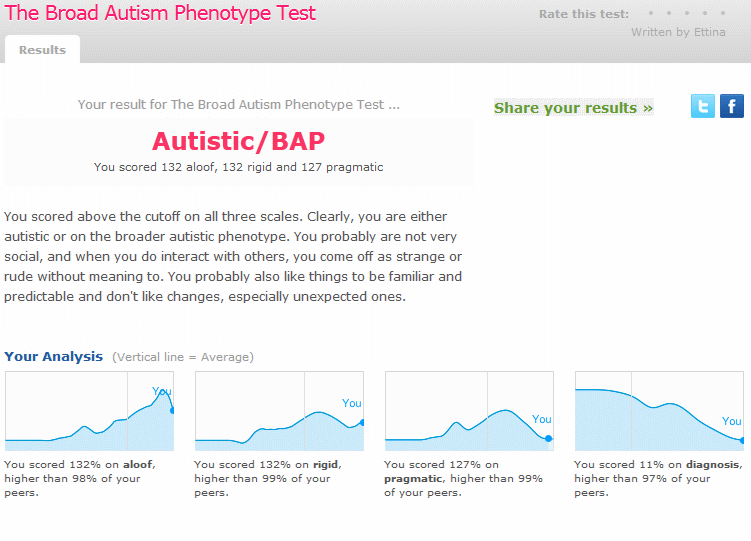
According to this test, taken on July 13, 2012, as if I were in my teens:
“Hi! Welcome to the Broad Autism Phenotype Questionnaire, taken from an article in the Journal of Autism and Developmental Disorders [abstract below] .... Ever since Leo Kanner first described autism, it's been observed that many autistics have relatives with autistic traits. Originally this was explained by the “refridgerator mother” theory, but more recently it’s been attributed instead to genetics. This questionnairre is designed to measure the mild autistic traits present in people who are not actually autistic but have a genetic predisposition to autism.”
The abstract for “The broad autism phenotype questionnaire” (J Autism Dev Disord. 2007 Oct;37(9):1679-90. Epub 2006 Dec 5.) reads:
“The broad autism phenotype (BAP) is a set of personality and language characteristics that reflect the phenotypic expression of the genetic liability to autism, in non-autistic relatives of autistic individuals. These characteristics are milder but qualitatively similar to the defining features of autism. A new instrument designed to measure the BAP in adults, the Broad Autism Phenotype Questionnaire (BAPQ), was administered to 86 parents of autistic individuals and 64 community control parents. Sensitivity and specificity of the BAPQ for detecting the BAP were high (>70%). Parents of children with autism had significantly higher scores on all three subscales: aloof personality, rigid personality, and pragmatic language. This instrument provides a valid and efficient measure for characterizing the BAP.”
Return to the top of the page.
|
XII. The PDD Assessment Scale/Screening Questionnaire
|
I took this test by Rami Grossmann, M.D., on July 22, 2013, first, as an adult and, second, while imagining that I was twelve-years old. The results may suggest “Severe PDD” (pervasive developmental disorder, now called Autism Spectrum Disorder)


Return to the top of the page.
|
XIII. The Ritvo Autism Asperger Diagnostic Scale-Revised (RAADS-R)
|
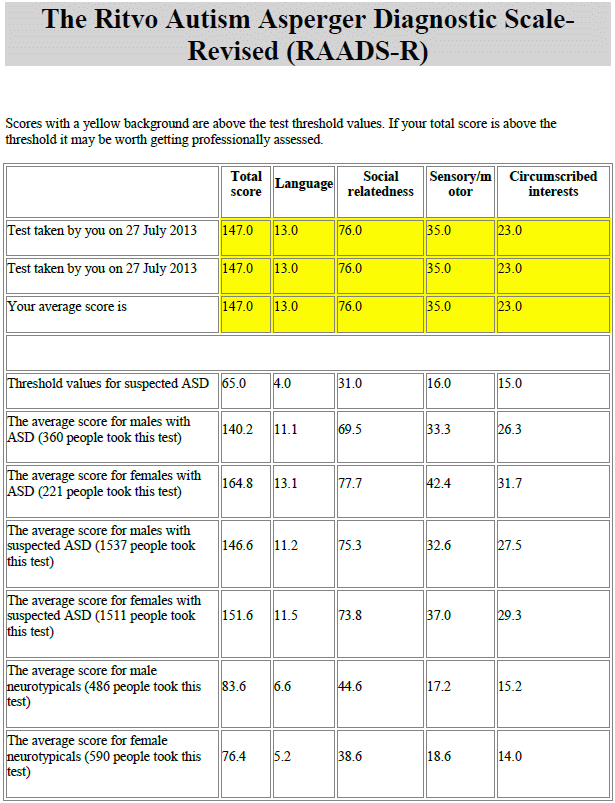
I took this test on July 27, 2013. Although I answered the questions for the present, the scoring system included options for below 16-years old, now, both, and neither. My score of 147 was highly in excess of the ASD threshold of 65. Complete details are in this PDF file.

Return to the top of the page.
|
XIII. The Monotropism Questionaire
|
I took this test on November 28, 2023. I am highly Autistic Complete details are in this PDF file.
Return to the top of the page.
|
XIV. Are You Highly Sensitive?
|
The Highly Sensitive Person is the term used by Elaine N. Aron, Ph.D., in place of sensory processing disorder, which can only be formally diagnosed by occupational therapists. Aron argues that being a highly sensitive person is not a disorder. Although Aron herself distinguishes between being a highly sensitive person and being an Asperger’s or a high-functioning Autistic, the large majority of those persons on Wrong Planet, both diagnosed and self-defined with Autism, who reported taking the test scored in the "highly sensitive person" range. Aron herself does not consider being a highly sensitive person to be a disorder and defines it here by posing a series of questions:
In Aron's Are You Highly Sensitive?: A Self-Test (7/8/13), I answered in the affirmative to 12 questions. According to Aron:
If you answered more than fourteen of the questions as true of yourself, you are probably highly sensitive. But no psychological test is so accurate that an individual should base his or her life on it. We psychologists try to develop good questions, then decide on the cut off based on the average response.
Therefore, I do not qualify as highly sensitive on this test.
Aron also conducts workshops for Highly Sensitive People under the name, LifeWorks.
Return to the top of the page.
|
XV. Codependency Tests
|
I took the Codependency Test on 10/20/07. The following information is from the results page:

You scored 23% Enabling, 12% Dependent, and 95% Stable!...
Congratulations!! You are a well-adjusted person. Chances are you have a lot of friends because they recognize that you are interested in being a 'real' friend and don't just look at them as someone to rescue or be rescued by. You will have much success with relationships if you keep up this healthy trend away from codependency. Thanks for taking my test, please rate it honestly! (If you skipped a significant number of questions, you may have gotten this category in error.)
My test tracked 3 variables How you compared to other people your age and gender:
You scored higher than 99% on Enabling
You scored higher than 99% on Dependency
You scored higher than 99% on Stability
With the Codependence Self-Test, taken on 10/26/07, my affirmative responses to only 4 out of 25 statements placed me in the least codependent category (0-5 out of 25).
... you have relatively healthy boundaries, confidence and wisdom in relationships. You can care about people without feeling responsible for their choices.
According to the Relationship Attachment Test - Abridged, taken on 12/6/07, my score is 0 out of 100. Here is their description of relationships and codependency:
When it comes to relationships, one would think that there could never be too much of selflessness and giving. However, for people with dependent personalities, selflessness is very problematic because it's driven by fear. Dependent individuals operate to avoid rejection, to keep their relationship intact, and to earn love. They often seek approval and validation from their significant others to the point of abandoning their own opinions, feelings, and values. Because the idea of abandonment generates trepidation and the feeling that they won't survive, dependent persons' desire to please their partner overrides their own individuality.
People with dependency problems usually team up with those who like to be in control. In the beginning, such relationships might seem just right because the two people involved complement one another and fulfill each other's needs. However, in a codependent relationship, the pleasure is sucked out of giving, and both partners end up unhappy, frustrated, and distressed. The controlling person often starts feeling suffocated and annoyed at the neediness of the other and the dependent person often end ups feeling taken advantage of and bitter. When the codependent relationship does finally crumble, the dependent person is worse off than s/he was at the beginning. S/he is left with no sense of self, and no one to take care of him/her.
Return to the top of the page.
|
XVI. NPA Personality Test by Anthony Martin Benis, Sc.D., M.D.
|
[Last I checked, the links in this section no longer worked. However, I PDFed a Wikipedia article (which Wikipedia has since deleted). Benis' YouTube account, which hosted his videos, has also been closed.]
I took this 50-question NPA test (narcissism, perfectionism, and aggression) on 11/17/07. It was developed by Anthony Martin Benis, Sc.D., M.D. (cardiology), and is based on concepts described initially by Karen Horney, M.D. (psychiatry). As to definitions:
Dominance is defined as, "Individuals having the trait are continually competing with each other on a scale of dominance and submission"; narcissism as, "The trait of narcissism may reveal itself in the context of conceit, exhibitionism, vanity and messianism"; and perfectionism as, "Acts associated with the trait are obsessiveness, compulsiveness, repetition, and the desire for neatness, order and symmetry. A clue to the nature of the trait lies in the compulsive, repetitive mannerisms of autistic children and some adult schizophrenic individuals."
The results in my own case were NP (P=1), which is construed by the author of the test as:
Narcissistic - perfectionist personality. Obsessive-compulsive personality.
Bovine personality. 'Nervous bird' personality. 'The quiet achiever.'...
An example of a borderline type is the N-P type ..... Narcissistic - perfectionisitic
borderline personality: This is the borderline or 'successful' autistic personality
(infantile autism: Kanner or Asperger syndrome).
Here are the particulars:
focus
your F-score = 63
0-20 = low: diffuse, expansive
20-70 = moderate: reflective, pragmatic
70-100 = high: contemplative, analytical
temperament
your T-score = 15
0-10 = low: phlegmatic
10-20 = low: reserved
20-30 = moderate
30-60 = high: reactive
60-100 = high: volatile
submissiveness, anxiety,
depression
your S-score = 65
0-30 = low
30-60 = moderate
60-100 = high
Your S-score was greater than 30 (elevated).
The S-score is a measure of anxiety, depression or submissiveness in social relations on a
scale of 0-100. If the score is >20, then it becomes likely that either trait N or A, or both,
is only partially expressed. This test does not explore the many possible reasons for a high
S-score. The most common reason is suppressed aggression (submissive types) or suppressed
narcissism (narcissistic borderline types). In individuals having consulted a mental health
professional common reasons might be depression or bipolar disorder. The T-score is a
measure of temperament, also on a scale of 0-100. Low temperament individuals tend to be
reserved or phlegmatic. High temperament individuals tend to be reactive or volatile. The F
score is a measure of the degree of organization of an individual's personality, again on a
scale of 0-100. Organized individuals with analytical tendencies will tend to score high on
this scale, while less focused, expansive or practical individuals will tend to score low.
Your character type tends to:
NP
(narcissistic-perfectionistic)
Since your S-score was elevated, it is probable that your character type is non-dominant:
Narcissistic-Perfectionistic (NPA-) Submissive.
Return to the top of the page.
|
XVII. Myers-Briggs Tests
|
There seems to be a strong correlation between those with Asperger syndrome or
high-functioning autism (HFA) and the INTP type of the Myers-Briggs Type Indicator (MBTI):
description 1, description 2. Another theory states that Asperger's correlates to the INTJ
personality type, whereas high functioning autism correlates to the INFJ personality type."
-- Aspergers Syndrome Characteristics
According to the Keirsey Temperament Sorter (taken 2/01), I am an INTP (Introverted-Intuitive-Thinking-Perceptive), the Architect:
Also, all Rationals (NTs) share the following core characteristics:
According to the Discover Your Perfect Career Quiz (taken on 5/27/08), I am an INTP:
People of this type tend to be quiet, independent and private; logical and unemotional; creative, ingenious and innovative, global thinkers; curious and driven to increase their competence; casual and adaptive; nonconforming and unpredictable.
The most important thing to INTPs is their privacy and the opportunity to solve complex problems in unique ways.
Great careers for INTPs
Here are just a few popular and often satisfying careers for people whose Personality Type is INTP:
Based on the Personality Test from Sonja Elen Kisa's website (taken on 11/19/07), I am an INTP:
|
Introverted (I) 86% Intuitive (N) 59% Thinking (T) 80% Perceiving (P) 68% |
Extraverted (E) 14% Sensing (S) 41% Feeling (F) 20% Judging (J) 32% |
The Jung Typology Test, from Human Metrics, also found me to be an INTP (on 11/16/07). I am a:

According to The Duniho and Duniho Life Pattern Indicator (V3.41), I am an INTJ or, if not, an ESFJ or an INTP.
Assuming that you are an INTJ,
Your DOMINANT function is Introverted Intuition.
Your AUXILIARY function is Extraverted Thinking.
Your TERTIARY function is Introverted Feeling.
Your INFERIOR function is Extraverted Sensing.
According to the TypeFocus Extravert-Introvert Report (December 3, 2008), I am an introvert.
|
|
The following comes from the "Rational Portrait of the Architect (INTP)" page on the Keirsey website:
Architects need not be thought of as only interested in drawing blueprints for buildings or roads or bridges. They are the master designers of all kinds of theoretical systems, including school curricula, corporate strategies, and new technologies. For Architects, the world exists primarily to be analyzed, understood, explained - and re-designed. External reality in itself is unimportant, little more than raw material to be organized into structural models. What is important for Architects is that they grasp fundamental principles and natural laws, and that their designs are elegant, that is, efficient and coherent.
Architects are rare - maybe one percent of the population - and show the greatest precision in thought and speech of all the types. They tend to see distinctions and inconsistencies instantaneously, and can detect contradictions no matter when or where they were made. It is difficult for an Architect to listen to nonsense, even in a casual conversation, without pointing out the speaker's error. And in any serious discussion or debate Architects are devastating, their skill in framing arguments giving them an enormous advantage. Architects regard all discussions as a search for understanding, and believe their function is to eliminate inconsistencies, which can make communication with them an uncomfortable experience for many.
Ruthless pragmatists about ideas, and insatiably curious, Architects are driven to find the most efficient means to their ends, and they will learn in any manner and degree they can. They will listen to amateurs if their ideas are useful, and will ignore the experts if theirs are not. Authority derived from office, credential, or celebrity does not impress them. Architects are interested only in what make sense, and thus only statements that are consistent and coherent carry any weight with them.
Architects often seem difficult to know. They are inclined to be shy except with close friends, and their reserve is difficult to penetrate. Able to concentrate better than any other type, they prefer to work quietly at their computers or drafting tables, and often alone. Architects also become obsessed with analysis, and this can seem to shut others out. Once caught up in a thought process, Architects close off and persevere until they comprehend the issue in all its complexity. Architects prize intelligence, and with their grand desire to grasp the structure of the universe, they can seem arrogant and may show impatience with others who have less ability, or who are less driven.
Albert Einstein as the iconic Rational is an Architect
Dr. David Keirsey, Robert Rosen, George Soros, Gregory Peck, James Madison, Ludwig Boltzman, Charles Darwin, Adam Smith, and Thomas Jefferson are examples of the Architect Rationals
Return to the top of the page.
|
XVIII. Enneagram
|
My observation, though not a particularly original one, is that Enneagram type 5, on face validity, appears to be the construct most isomorphic with the Autism spectrum.
According to the Riso-Hudson Enneagram Type Indicator (RHETI), taken on 11/16/07, I am type 5 ("The Thinker"), defined as the "perceptive, cerebral type." A descriptive statement would be, "I need to understand the world."
Based on the Enneagram Personality Test (taken on 7/6/09), "Your main type is which ever behavior you utilize most and/or prefer. Your variant reflects your scoring profile on all nine types: so = social variant (compliant, friendly), sx = sexual variant (assertive, intense), sp = self preservation variant (withdrawn, security seeking)."
|
Diagram 6: Main Type

Diagram 7: Overall Self
 |
|
According to The Quick & Painless ENNEAGRAM Test (taken on 11/17/07), my type is five (the Observer and Thinker).
"I need to understand the world"
Observers have a need for knowledge and are introverted, curious, analytical, and insightful.
How to Get Along with Me
What I Like About Being a FIVE
What's Hard About Being a FIVE
FIVEs as Children Often
FIVEs as Parents
According to, Enneagram Test with Instinctual Variant (taken on 11/23/07):
You are most likely a type 5 (the Investigator) with 4 wing [and are a] Sexual variant
People of this personality type essentially fear that they don't have enough inner strength to face life, so they tend to withdraw, to retreat into the safety and security of the mind where they can mentally prepare for their emergence into the world. Fives feel comfortable and at home in the realm of thought. They are generally intelligent, well read and thoughtful and they frequently become experts in the areas that capture their interest.... Fives are often a bit eccentric; they feel little need to alter their beliefs to accommodate majority opinion, and they refuse to compromise their freedom to think just as they please....
... Fives fear being overwhelmed, either by the demands of others or by the strength of their own emotions. They sometimes deal with this by developing a minimalistic lifestyle in which they make few demands on others in exchange for few demands being made on them....
Fives, especially with the Four wing, sometimes mistype themselves as Fours. Such Fives recognize that they have strong emotions and don't identify with the often extremely cerebral portrait of type Five. But, Fives, unlike Fours, always retain some degree of discomfort when it comes to the expression of their emotional states. However much facility they may gain with it, the language of emotion is not their native tongue.
And, on this page of the site:
People of the sexual variant are very much interested in one to one contacts. They are looking for intimacy and this may show in sexuality, though not necessarily. Being in a relationship is very important to them. They are the most passionate of the subtypes, being temperamental and having more energy. They have less of a problem with getting into a fight and care less about rules and responsibility.
Here is a useful summary (11/17/07):
Seeking control over their lives, Fives seek to increase their competency by withdrawing into their minds to gain knowledge. Fives tend to live in the mental world of ideas rather than in the outside world. They are good at creating systems, but their need to be in control makes it difficult for them to work within systems. They tend to work better outside the system than within it. At their best, Fives understand things more deeply than other people and advance science and human knowledge by sharing their insights. Stephen Hawking is an excellent example of a Five at his best. Although wheelchair-bound and almost completely paralyzed, Hawking lives in his mind, exploring the secrets of the universe.
Return to the top of the page.
|
XIX. Personality Disorder Tests
|
|
Personality Disorder Test Results (7/22/2013) 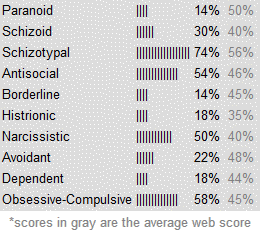
personality tests by similarminds.com This next test was taken on 2/23/2008:
The Personality Disorder Quiz was taken on 6/14/2008:
Diagram 8: Personality Disorder Quiz
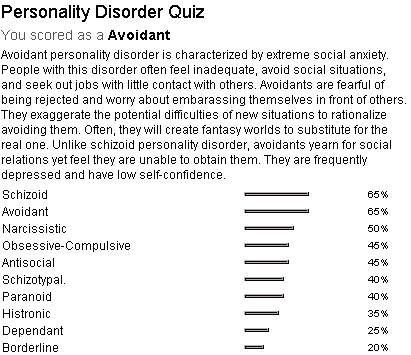
According to the What Personality Disorder Are You? test, taken on 6/14/2008:
Diagram 9: What Personality Disorder Are You?

According to the The Cluster A Personality Disorder Test , taken on 6/14/2008, I scored highest for schizoid (7 points), followed by paranoid (3 points) and schizotypal (1 point). Based on the What's Your Personality Disorder test, taken on 6/14/2008, I have schizoid personality disorder. From the Schizotypal Personality Test (SPTA), these were my scores:
Ideas of reference: 0 out of 9 (unsure: 0) Within the population in which the instrument was created, the mean scores were 26.9 (sample 1) and 26.3 (sample 2). Therefore, my mean of 15.5 was only slightly elevated. Return to the top of the page.
According to the Adult ADHD Test, taken on 9/27/2008:
You scored a total of 22
Here is the scoring key for the above test:
Diagram 10: Adult ADHD Scoring Key

The same site has a Quick Adult ADHD Screening Test, which I also took on 9/27/2008:
You scored a total of 6
Here is the scoring key for the above test:
Diagram 11: Adult ADHD Scoring Key

This is the graphic generated for both of the above tests:
Diagram 12: Adult ADHD Score

According to the Attention Deficit Disorder/ADD Test, taken on 9/24/2008:
Dr. Amen [Daniel G. Amen, M.D.] suggests: "More than 20 items with a score of three or more indicates a strong tendency toward ADD. Your total number of items with a score above three is 17.
Based on this calculation, you DO NOT HAVE a strong tendency toward ADD. According to the Adult ADD/ADHD Screening Quiz, taken on 3/25/2008, my score was below 70, which is not associated with ADHD. "Your answers to this adult ADHD screening test suggest that you are not in the range associated with a high probability of ADHD." According to The Adult ADD Screener, taken on 3/25/2008, from the World Health Organization's Composite International Diagnostic Interview, "Your responses do not indicate a likelihood of Adult ADD." According to the ADHD Self Test, taken on 3/25/2008, "Based on your answers, sufficient signs and symptoms of ADHD are probably not present." Return to the top of the page.
In both of the following tests, I simply guessed. I am awful at remembering faces. From the Online Cambridge Face Memory Test, taken on June 5, 2008:
Out of 72 faces, you correctly identified 48. In other words, you got 67% correct.
On our previous version of this test, the average person with normal face recognition was able to recognize about 80% of the faces. If you correctly identified less than 65% of the faces, this may indicate face recognition difficulties. On the Famous Faces Test, taken on June 5, 2008:
Out of 30 faces, you correctly identified 10. You were familiar with 26 of the people in
this test.
If we exclude the ones you were unfamiliar with, you got 38% correct. On our previous version of this test, the average person with normal face recognition was able to recognize about 85% of the faces they were familiar with. If you missed more than half of the faces you were familiar with, this may indicate face recognition difficulties. Return to the top of the page.
According to the Yale-Brown Obsessive Compulsive Scale (Y-BOCS), taken on September 27, 2008:
Your YBOCS Score is 19, which is in the moderate range.
According to the Obsessive-Compulsive Disorder (OCD) Screening Quiz, taken on September 27, 2008:
You scored a total of 2.
You have answered this self-report questionnaire in such a way as to suggest that you do not likely currently suffer from an obsessive-compulsive disorder. You should not take this as a diagnosis or recommendation for treatment in any way, though. According to the University of Hamburg Obsession-Compulsion Inventory Screening Form, completed on September 27, 2008, I only have two obsessions and one compulsion. According to the scoring criteria:
If the total number of true answers circled for these questions is 1 or 2: You probably do not have clinically significant obsessions....
If the total number of true answers circled for these questions is 1,2,or 3: You probably do not have clinically significant compulsions. According to the Online OCD Test, taken on September 27, 2008, there is a 60% chance I have OCD. According to the Adult OCD Self Test, taken on September 27, 2008:
Your results show that you may be experiencing some symptoms associated with obsessive-compulsive behavior. You might find it beneficial to speak with a mental health care provider in your area to learn more about your options for diagnosis and treatment.
According to The Florida Obsessive-Compulsive Inventory OCD Screening Test, taken on September 27, 2008:
Based on the above results, it appears you may have OCD or a related disorder. However, only a qualified mental health provider can make a more accurate diagnosis. If you are experiencing psychological distress it may be advisable to see a clinician for further evaluation.
According to The Do You Have OCD Test, taken on September 27, 2008, I have mild OCD. According to Yale-Brown Obsessive Compulsive Scale (Y-BOCS), taken on September 27, 2008:
Your YBOCS Score is 19, which is in the moderate range.
Return to the top of the page.
According to this test for Psycho Trauma Exposure (PTE), from SLS Residential (taken on October 27, 2008), "Your Score Is 210 of a possible score of 400. The average score for men in the age range 50-59 is 161."
You are reporting severe levels of trauma and probably should consult with a behavioral health professional with expertise in traumatic stress to have this assessed. The American Academy of Experts in Traumatic Stress can help you find a specialist at www.aaets.org.
Return to the top of the page.
On this test (taken on January 29, 2009) of being able to accurately match the photographs of ten faces with seven facial expressions (sad, angry, surprise, fear, disgust, contempt, and happy), I correctly identified only two out of ten. Return to the top of the page.
My Sex I.D. Profile, from the BBC, is in this PDF file. I noted, in particular:
Your empathising score is 8 out of 20. This is an indication of your ability to read and respond to others' emotions.
Your systemising score is 12 out of 20. This indicates how much you enjoy exploring the intricacies of systems, for example playing strategy games and putting together flat pack furniture. this:
Out of 10 pairs of eyes, you matched 4 with the correct mood.
Return to the top of the page.
The minimum rating on Dr. Richard Boylan’s Star Seed Identification Questionaire for being a Star Seed Adult (or Child) is 12. On December 25, 2012, I scored 14. Supposedly, this means that, although I have two earthly parents, my origins are partially extraterrestrial through: gene splicing, advanced biomedical technology (of extraterrestrials), from a “walk in” (in which my soul was replaced with the soul of an extraterrestrial visitor), through sharing my consciousness with an extraterrestrial, or (most commonly) as a chosen earth missionary (emissary). These individuals do not necessarily know that they are Star Seed People. One of the questions, to which I responded affirmatively, asked me about being an Asperger’s Autist. (Well, at least the idea is entertaining.) On January 8, 2013, I qualified as a “walk-in” and starperson, based on Doreen Virtue’s quiz. According to another test, taken on January 8, 2013, “Congratulations! You are an Indigo Adult! (100%)” (roughly, an individualistic earthly human who has unusual traits and may display supernatural abilities) Based on another test, taken on January 9, 2013, there is a 53% chance that I was abducted by aliens. From another test, also taken on January 9, 2013, “Your score indicates a suspicious number of events in your background commonly experienced by other abductees. You may want to explore the abduction possibility further.” After taking an “alien implant” test, on January 9, 2013, there is a 65% chance I have one (perhaps in the right middle of my back). All of these questionaires are included in this PDF file.
Some children who have autism and those with Asperger’s Syndrome are also Indigo Children ....
Wendy Chapman, “Who are the Indigo Children?” Metagifted Education Resource Organization. 1998-2013. Retrieved on January 10, 2013.
Do Adult Indigos exist? YES!!! They did not just start coming at rates of 90% of the incoming population in 1992. I believe there have always been some Indigos, the amount of which has only increased through the last 50 years or so. My guess on percentages is that Indigos make up approximately 15-25% of 20-30 year olds, 10-15% of 30-40 yr olds, 5-10% of 40-50 yr olds and 0-5% prior to that time.
Wendy Chapman, “Adult Indigos” Metagifted Education Resource Organization. 1998-2013. Retrieved on January 10, 2013.
Indigos are ... purported to be energetically vibrating at a higher frequency and are scrambled by negative energy (human or machine), and have more problems with food and environmental sensitivities—these issues are observed in most children diagnosed with Asperger’s Syndrome as well as many other Autistic Spectrum Disorders. Children with these disorders often have difficulty with sensory overload and are unusually sensitive to sound, smell or taste and very often extremely sensitive to touch....
It is my belief ... that the “Indigo Phenomenon” is merely a convenient way for parents who are, for some reason unwilling to acknowledge their children’s neurodiversity, and would rather label them as something non-human ie descended from another race far, far away.
Charlet C. Estes. “Indigo Blues.” SkepticReport. December 1, 2003. Retrieved on January 11, 2013.
Return to the top of the page.
Copyright © 2007- Mark A. Foster, Ph.D. All rights reserved. 
| ||||||||||||||||||||||||||||||||||||||||||